An IT Services Company might know a Key Account, identify a need, have the right consultant, and agree on the rate with the business manager. However, procurement can halt the sale: the IT Services Company may not be authorized on the account, or may no longer be.
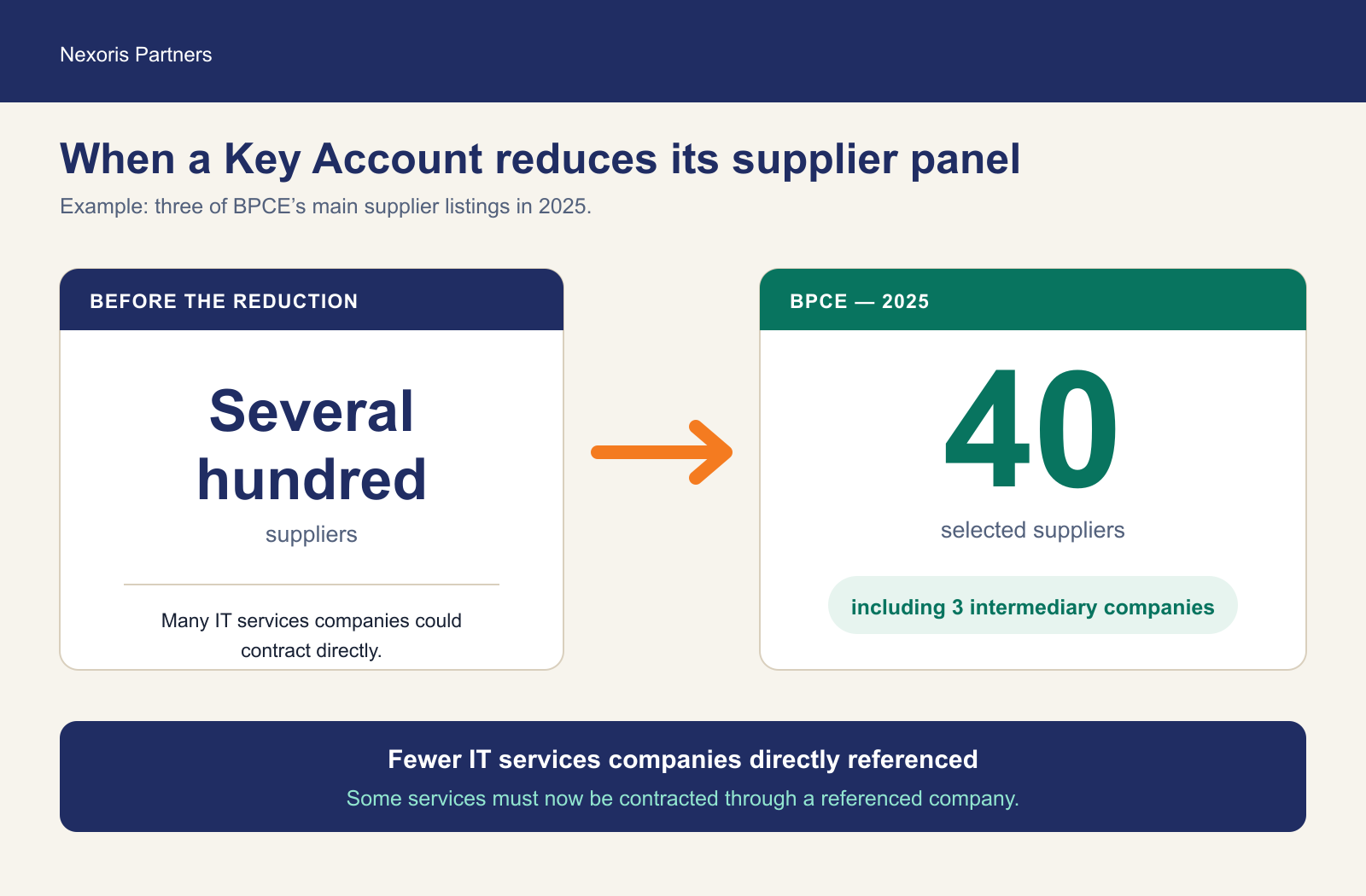
By 2025, BPCE reduced the number of selected suppliers to 40 on three of its main listings, down from several hundred previously. Among these 40 suppliers are three intermediary companies. The IT Services Companies excluded from the panel can maintain their relationships with the business units and provide the sought-after consultants, but they can no longer contract directly. They must rely on a referenced company.
For about ten years, intermediary companies have increasingly taken their place in this market. They aggregate suppliers, disseminate calls for tenders, source profiles, or provide Payroll Management Services for already won contracts.
The reduction of panels shifts an increasing portion of demand towards intermediary companies, at the expense of IT Services Companies who access Key Accounts less frequently directly. However, this progress comes with stricter constraints. Procurement now regulates their rates and, increasingly, their intermediary margin. These constraints force them to adapt their organization and business model, which IT Services Companies and consulting firms could benefit from.
IT Services Companies are therefore encouraged to collaborate more with intermediary companies, whose practices can greatly differ. Some disseminate their calls for tenders to a large number of suppliers or impose exclusivity with a client. Others select a few partners by skill, allow them to use other channels freely, and do not obstruct future direct access if they obtain their own referencing. An IT Services Company must take these differences into account when choosing the intermediary companies it wishes to work with.
Intermediary companies have become full-fledged suppliers to Key Accounts
Procurement departments have long primarily worked with IT Services Companies and consulting firms. They negotiated their pricing grids, occasionally requested free days or year-end discounts but did not negotiate their internal margin.
Then, intermediary companies took their own place in the procurement organization. Inop's, Alliance High Tech, Little Big Connection, or BeTeam proposed to Key Accounts to aggregate suppliers and disseminate needs to communities of IT Services Companies and consulting firms. They could save procurement time by reducing the number of contracts and contacts to manage.
Around the same time, freelance platforms developed. Freelance.com, Le Hibou, Malt, Opteamis, Freelance Republik, or Nexoris organized access for Key Accounts to communities of freelancers. Some players were primarily built around a matchmaking tool. Others were organized on a model similar to an IT Services Company, with commercial and operational teams working mainly with freelancers.
Procurement took time to define its position towards these new players. Should they reference them as traditional suppliers? Apply the same pricing grids as for IT Services Companies? Regulate their mark-up? The answer gradually became clearer: intermediary companies became referenced suppliers, but procurement seeks to control their commissions more closely.
Market concentration and convergence of activities
The market has concentrated over the past few years, with the acquisition of Comatch by Malt, Inop's by Freelance.com, and LeGratin.io by Nexoris.
Previously, the players were more specialized. Some primarily provided Payroll Management Services for projects brought by IT Services Companies. Others disseminated calls for tenders from Key Accounts to a community of IT Services Companies and consulting firms. Freelance platforms concentrated their activity on researching and placing independent consultants.
These specializations are less pronounced today. The same intermediary company can receive calls for tenders from a Key Account, search for freelancers, or solicit IT Services Companies to respond, then provide Payroll Management Services for other projects already won by these players.
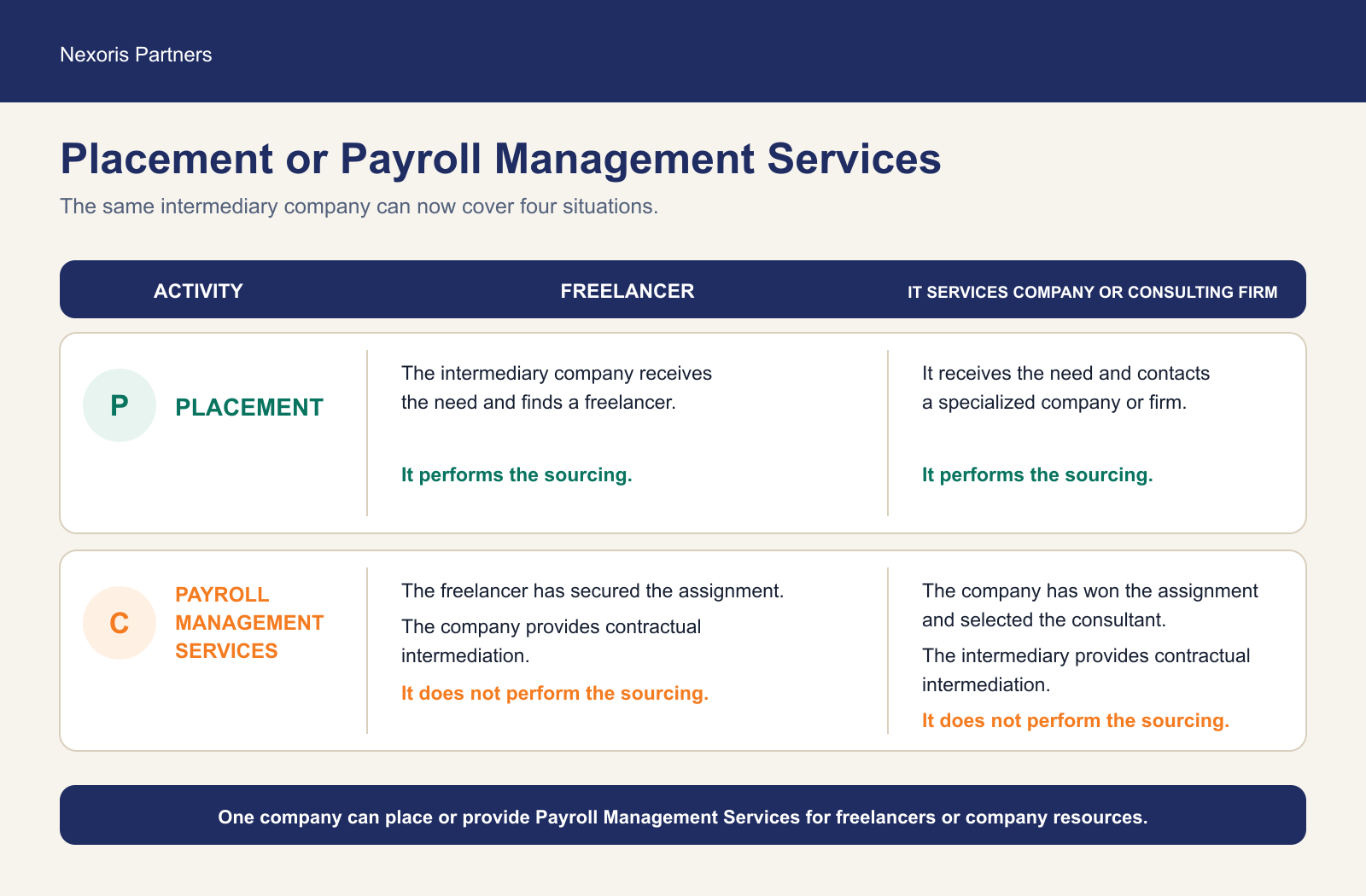
Placement and Payroll Management Services, however, remain two distinct activities. In a placement, the intermediary company receives a client need or escalates it, and then seeks the resource that can fulfill it. They can solicit their community of freelancers but also IT Services Companies and specialized consulting firms.
In Payroll Management Services, the assignment and the resource have already been identified. The freelancer has secured the assignment, or the IT Services Company has won the opportunity and selected the consultant it wishes to propose. The intermediary company does not perform the sourcing: it provides contractual intermediation with the client where it is referenced.
Procurement is putting pressure on intermediary companies’ commissions
Procurement departments now apply pricing grids to intermediary companies and also put pressure on their commissions. This is a major difference from IT Services Companies and consulting firms: procurement may negotiate their prices and commercial terms, but it does not negotiate their internal margin. For intermediary companies, the commission itself has become part of the negotiation.
For Payroll Management Services, the market stood at around 5% a few years ago. It is now moving towards 3%, with 5% as the upper limit. For placement and the sharing of calls for tenders, target mark-ups range from 8% to 13%.
By directly controlling commissions, procurement treats intermediary companies as channels for connecting suppliers with clients and processing transactions. It does not remunerate them in the same way as IT Services Companies that build a commercial and operational understanding of a client over several years. Intermediary companies must therefore reduce their processing costs without weakening their understanding of requirements or the quality of their network.
Why some intermediary companies will work more closely with IT Services Companies
A freelance community cannot cover every Key Account requirement. It is well suited to many time-and-materials assignments, but less able to address demand for more junior profiles or fixed-price services.
An intermediary company that works only with freelancers needs substantial teams of Talent Acquisition Specialists to cover every market segment properly. Relying on AI alone would be unrealistic. Sourcing is not simply matching a CV with a requirement. It involves identifying and contacting people, checking their availability, assessing them, taking references, and ensuring that both their technical skills and soft skills fit the client’s environment. Under margin pressure, some companies may prefer to work more extensively with IT Services Companies and specialist consulting firms rather than continually expanding their internal teams.
Platforms and intermediary companies already compete with IT Services Companies on certain requirements because they may propose freelancers to the same client. They can also become partners by sharing calls for tenders or providing Payroll Management Services for assignments already won.
Future transformations: scenarios to watch
Lower commissions could accelerate market concentration and encourage intermediary companies to work more extensively with IT Services Companies. Those that previously relied almost exclusively on freelancers may share more calls for tenders with IT Services Companies and specialist consulting firms to cover a broader range of skills, more junior profiles and fixed-price services.
Some could also add salaried consultants in specific fields. In the medium term, some intermediary companies may also offer competency centres or service centres, either alone or in partnership with IT Services Companies.
Two business opportunities for IT Services Companies
The first opportunity is Payroll Management Services. An IT Services Company that has won an assignment but cannot contract directly with the client can use a referenced intermediary company. Before these companies became established, it sometimes had to work through another referenced IT Services Company and pay a commission of 10% to 20%. Payroll Management Services at 3% to 5% leave more room for the IT Services Company to finance its business development, delivery and consultants.
The second opportunity is access to calls for tenders. Intermediary companies receive a larger share of Key Account requirements. Those that open their networks to IT Services Companies can share opportunities that these companies would not otherwise have received, particularly for more junior profiles or fixed-price services. An IT Services Company should not try to respond to everything. It should be identified in the areas where it has genuine credibility.
How to choose intermediary companies
Being referenced by a Key Account is not enough to make an intermediary company a good partner for an IT Services Company. Seven criteria can be used to assess it.
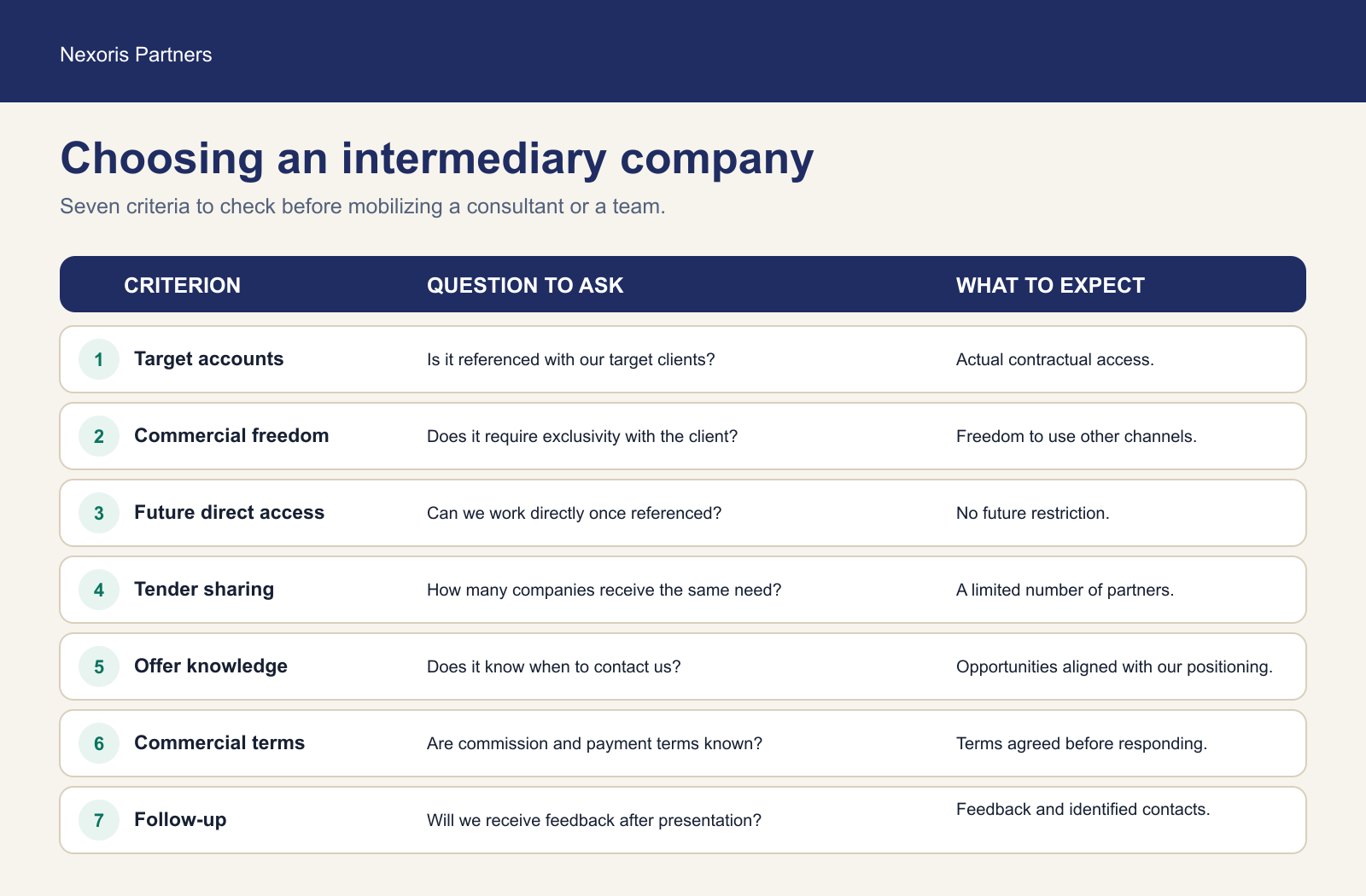
Is the intermediary company present in the accounts that matter to us? Its client listings should enable the IT Services Company to contract for an assignment it has already won or receive requirements that genuinely match its capabilities.
Do we retain our commercial freedom? Some companies require an IT Services Company to work exclusively through them for a given client. The IT Services Company needs to know whether it can use another channel or work directly with the client once it obtains its own listing. A partnership should not block future direct access to an account.
Some intermediary companies also become involved in the delivery of assignments. Their involvement in follow-up may be understandable when they provided the call for tenders and completed the placement. For Payroll Management Services, however, the IT Services Company has already developed the client relationship, won the assignment and selected the consultant. The intermediary company does not replace the IT Services Company in the operational management of the engagement.
How are calls for tenders shared? A call for tenders sent to fifty IT Services Companies does not have the same value as a requirement shared with a small number of selected partners. Before responding, the IT Services Company should know what information is available about the requirement, the client, the expected delivery model and the number of competitors.
Does the intermediary company understand our offering and respond quickly? A good contact knows why they are approaching the IT Services Company, understands its capabilities and can say whether its consultant will be presented. They provide feedback after interviews or submissions. Without this relationship, the IT Services Company responds blindly and ties up available resources unnecessarily.
Is the relationship built for the long term? The intermediary company should understand the accounts targeted by the IT Services Company, its capabilities and the services it can deliver. This knowledge enables it to approach the IT Services Company with relevant opportunities without starting again from scratch for every call for tenders.
Are the commercial terms clear? The IT Services Company should know the commission, payment terms and applicable conditions before presenting its consultant. Advance payment may be valuable when it needs to finance the start of an assignment before the Key Account pays.
What complementary services are genuinely useful? An intermediary company can also provide tailored freelance sourcing for the IT Services Company’s own requirements or offer Third Parties Umbrella Services. When a freelancer is sourced for an IT Services Company, that freelancer works as its direct subcontractor: the intermediary company is not part of the contractual chain for the assignment.
Nexoris, an IT Services Company and intermediary company partnering with IT Services Companies and consulting firms
Nexoris has been working with IT Services Companies and consulting firms for over ten years. This collaboration initially focused on providing Payroll Management Services for their consultants working with Nexoris clients. It was then extended to tailored freelance sourcing for their own needs. Since 2025, Nexoris has also provided them with a platform where they can view assignments and submit their consultants.
With the acquisition of LeGratin.io, Nexoris is also contributing to the consolidation of the intermediary company market. From September 2026, the company will share more of the calls for tenders received from its clients with partner IT Services Companies and consulting firms, alongside the searches conducted within its freelance community.
This approach will not involve systematically sending every call for tenders to a large number of companies. Partners will be selected client by client and capability by capability. Nexoris wants to understand their expertise and, over time, their ability to assemble a team or deliver fixed-price work.
IT Services Companies will be able to speak with contacts who understand their offering, explain their positioning and decide whether to mobilise their strongest profiles. The aim is to build a long-term working relationship, rather than occasionally approaching one IT Services Company among dozens of others.
Another important point for IT Services Companies is that Nexoris does not require them to work exclusively through Nexoris for a given client. An IT Services Company can use Nexoris to provide Payroll Management Services for an assignment or gain access to an opportunity without entrusting all of its work for the same client to Nexoris. Nexoris also does not block future direct access when the IT Services Company subsequently obtains its own listing with the client. Depending on the circumstances, Nexoris may offer advance payment facilities.
What IT Services Company leaders should take away
For each target account, an IT Services Company leader now needs to know whether the company can contract directly, which intermediary companies are referenced there and which of them can provide calls for tenders that genuinely match its capabilities.
When an assignment has already been won, the choice mainly concerns the terms of Payroll Management Services, the IT Services Company’s freedom in its client relationship and the possibility of obtaining a direct listing in the future. When the intermediary company provides the call for tenders, the IT Services Company also needs to know how many partners have been approached, the quality of the information provided and the feedback it will receive after submitting a consultant.
If intermediary companies share more of their calls for tenders with IT Services Companies, those companies will need to be clearly identified in the areas where they have genuine credibility. They will also need to specify the accounts they want to develop and the services they can deliver: providing a consultant, assembling a team or working on a fixed-price basis.
To discover Nexoris solutions for IT Services Companies and consulting firms, or to present your offering, contact a Nexoris Partners Business Partner.