Why?
Because between the client request and the proposal of a truly mobilizable profile, there is a lead time many organizations still underestimate.
Today, clients expect a fast response, but also a reliable one. They want qualified, available and validated profiles, often within 72 hours.
That is where time is lost.
And it is this lead time that loses the assignment.
Some IT Services Companies move fast. Others stack up steps, validations and uncertainties.
It is precisely on this chain that some agentic AI approaches can step in.
Not to replace staffing, but to make it more fluid.
In short: 4 key takeaways
Staffing lead time often comes from the chaining of steps more than from a lack of profiles.
Agentic AI helps to simplify and chain these steps faster.
It mainly works on structuring the need, activating the talent pool and prioritizing profiles.
It does not replace the organization. It accelerates an already structured model.
The real friction point in IT Services Company staffing
In many IT Services Companies, the issue is not access to profiles.
Teams already have contacts, databases and partners.
The friction lies elsewhere.
It appears the moment a need has to be turned into a concrete response.
The need has to be understood. The profiles have to be identified. Their availability has to be checked. Then someone has to decide which one to propose.
Each step is legitimate. But chaining them creates delay.
And that delay is enough to lose the assignment.
Why do current steps create delay?
The way it works is often the same.
The need is captured by sales. It is reformulated by recruitment. Profiles are searched, then qualified. Then come internal validations.
This way of working is not bad. It is simply sequential.
Each step depends on the previous one. And each step adds time.
On top of that, much of the work is manual.
Briefs need to be re-read, profiles browsed, information verified, consultants followed up. Even with a large talent pool, activation remains slow.
It is not the search that slows things down, but the time between each step.
How does agentic AI step in concretely?
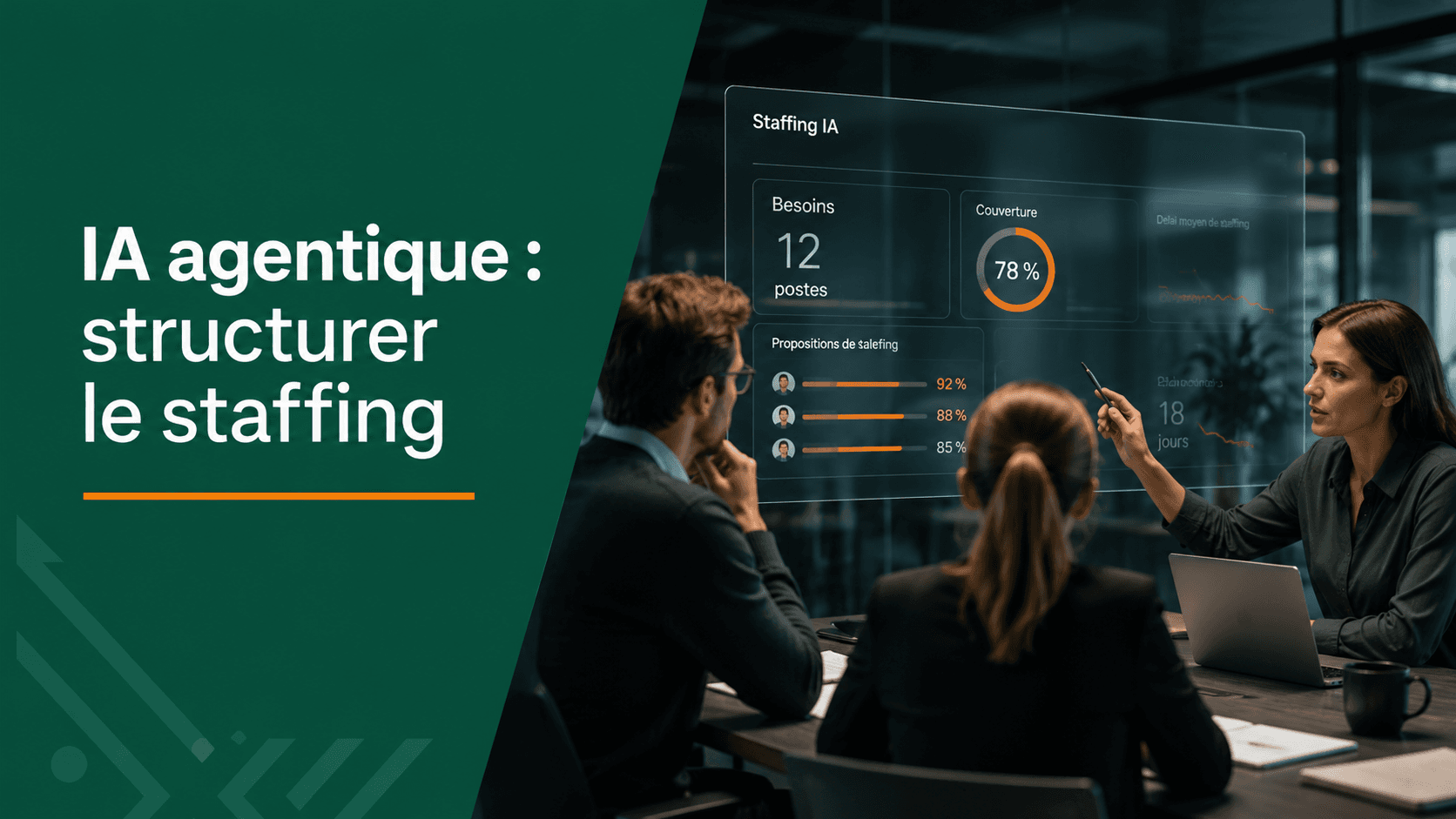
An agentic AI is an AI capable of chaining several actions autonomously to reach an objective. In staffing, that means going directly from a client need to a shortlist of truly usable profiles.
An agentic AI doesn't just analyze. It acts and chains the steps of the process. Concretely, it steps in where time is lost.
First, it structures the need as soon as it comes in. A brief, even a partial one, is turned into clear criteria. Expected skills are spelled out, priorities are set and constraints are identified.
Then it activates the talent pool. It queries all available data and quickly identifies relevant profiles, without restarting a manual search.
But above all, it surfaces mobilizable profiles. It takes availability, context and real-world constraints into account. That way it avoids surfacing profiles that look interesting on paper but cannot actually be used in the timeframe.
Finally, it makes the decision easier. Profiles are compared on simple criteria. The differences are visible. Prioritization becomes clearer.
The decision remains human. But it is made faster, with less uncertainty.
What an agentic logic changes in staffing
With this kind of approach, the process doesn't change in nature. But it changes in tempo.
The steps don't go away. They follow each other faster:
- The need is structured earlier.
- Profiles are identified faster.
- The selection is clearer.
- The decision is smoother.
- The process becomes directly usable by the teams.
This shortens the time between the client request and the proposal.
And above all, it reduces hesitation and back-and-forth.
Where to start to integrate this kind of approach?
An IT Services Company doesn't need to overhaul its entire model to benefit from these approaches.
The starting point is often simple.
First, structure the existing data. A usable talent pool relies on up-to-date information, clearly identified skills and visibility on availability.
Then, clarify the decision rules. Who validates? Based on which criteria? When? Without a clear framework, even the best tools remain underused.
Finally, start with a limited scope. For example, a recurring type of assignment or a specific area of expertise. This makes it possible to test, adjust and gradually scale up. To go further on the fundamentals of structured sourcing, see our article on reducing time-to-staffing.
The limits to be aware of
Agentic AI doesn't fix a disorganized model.
If the talent pool is not up to date, if the data is incomplete or if decision rules are unclear, it will not produce better results.
It may even speed up errors.
Furthermore, it doesn't replace human qualification.
Validating a profile, securing their commitment, and assessing their fit with a client context remain essential.
What impact on IT Services Company performance?
When an IT Services Company improves the fluidity of its staffing, the effects are visible quickly.
Responses come in earlier. Profiles are more relevant. The conversion rate goes up.
But the impact doesn't stop there.
Internal workload goes down. Teams spend less time searching and screening. They focus more on validation and the client relationship.
Predictability also improves. Lead times become more consistent. Activity is more readable.
Our take
At Nexoris Partners, we see that profiles already exist in most cases.
The real challenge is to mobilize them quickly, within a reliable framework.
That is why our model rests on a qualified talent pool, rigorous selection and the ability to surface activatable profiles within 48 to 72 hours.
Some AI-based approaches can reinforce this logic.
They allow us to move faster on identification and prioritization. But they don't replace the work of structuring.
What to take away?
Agentic AI doesn't bring a complete break. Above all, it removes wasted time.
It acts on the friction points of staffing, without changing its fundamentals.
The IT Services Companies that will get the most value from it are the ones that have already structured their ability to respond.
Because in the end, the difference remains the same. It is not the IT Services Companies that find the most profiles that win. It is the ones that know how to put them forward at the right time.