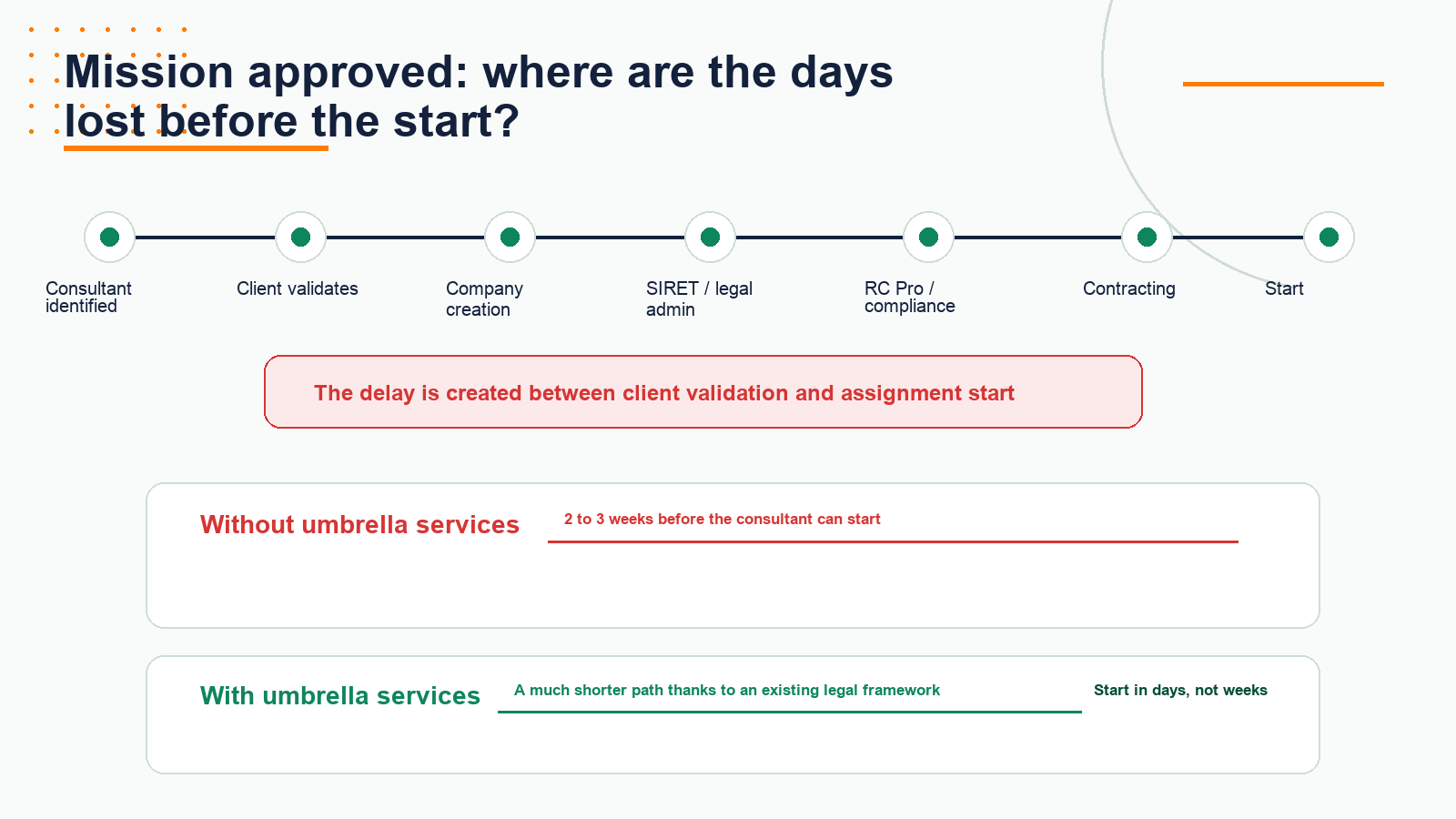
When a consultant embarks on freelancing, setting up their structure can delay the start of a mission that has already been validated by the client.
In many IT Services Companies and consulting firms, this scenario is well-known. The client validates the mission. The consultant is identified. The need is urgent. Yet, the start does not happen immediately.
The reason is not always commercial. It is often administrative. The consultant has just embarked on their journey, comes from a permanent contract, or has not yet finalized their legal structure. As long as this framework is not in place, the contracting process can slow down, directly affecting the IT Services Company's ability to start quickly.
In a market where responsiveness is as important as the quality of the profile, waiting for the complete creation of a company can become a real friction point. As we explain in our article on the time-to-staffing in IT Services Companies, every avoidable delay weighs on the ability to launch a mission under optimal conditions.
The Third Parties Umbrella Services specifically address this type of situation. They enable a consultant to work within an already operational framework, without waiting for the immediate creation of their own structure.
In short
- When a consultant embarks on freelancing, creating their company can delay the start of a mission that has already been validated.
- For an IT Services Company, the risk is twofold: delaying the mission or proceeding without a sufficiently clean administrative framework.
- Third Parties Umbrella Services allow the consultant to work within an already operational framework, without waiting for their structure to be finalized.
- This becomes particularly useful when the mission is urgent, the consultant is available, but their company is not yet ready.
- Its benefits do not stop at the start: it also facilitates the provision of compliance documents throughout the mission.
Summary
- Why creating a structure delays the start of a mission
- What Third Parties Umbrella Services change in this type of situation
- Third Parties Umbrella Services don’t speed up everything, but they remove a major barrier
- Real case: an urgent mission to be launched in a few days
- Securing administrative compliance throughout the mission
- In which cases do Third Parties Umbrella Services become particularly useful?
- What we think about it
Why creating a structure delays the start of a mission
Creating a company is not just about "opening a status." In practice, several weeks may pass before all elements needed for contracting are in place.
For a consultant who has just started, these steps are normal. But for an IT Services Company that needs to start a mission quickly at a client’s site, they can create a gap between commercial validation and actual start.
The question is not just when the consultant will create their company. The real question is about the risk.
Is the client ready to delay the start of a validated mission while waiting for the consultant to finalize their legal structure?
In some contexts, this delay can slow down a project, disrupt a schedule, or even jeopardize the launch of the mission.
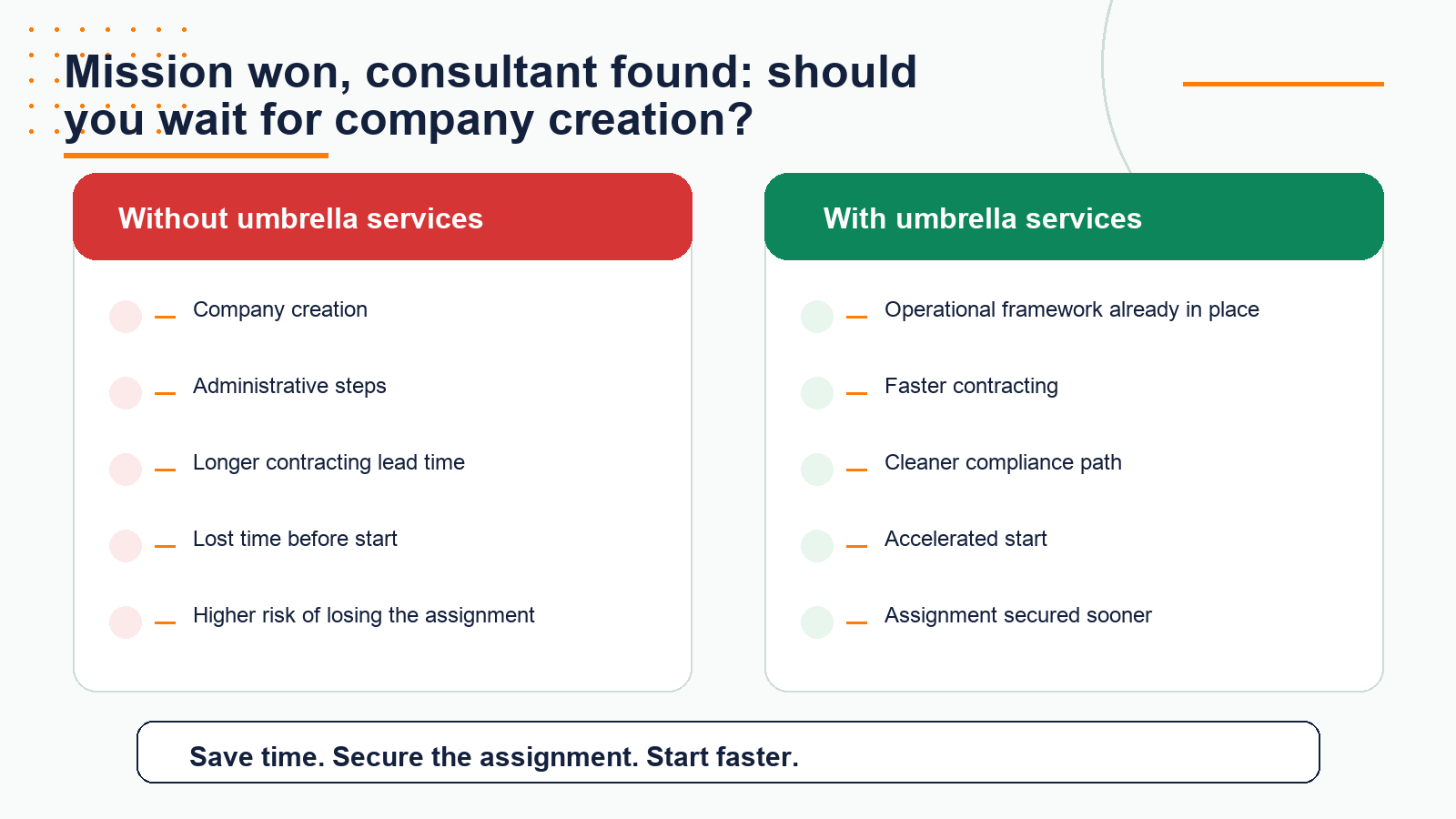
The challenge is therefore less about waiting for the company to be created and more about enabling the consultant to intervene quickly within an operational, compliant, and secure framework.
What Third Parties Umbrella Services change in this type of situation
Third Parties Umbrella Services allow the consultant to intervene without having to immediately create their own structure.For an IT Services Company or consulting firm, this changes the logic of the start. Instead of waiting for the consultant to be fully structured from a legal and administrative standpoint, it becomes possible to rely on an already established framework.Specifically, Third Parties Umbrella Services allow for:
contracting within 24 hours on average;
avoiding delays related to company creation;
- securing the mission’s start;
- reassuring the client about execution capacity;
- reducing administrative friction for the consultant.
- The topic is therefore not just administrative. It directly impacts delivery. When a mission is validated, every day gained between the client agreement and consultant start matters.
- Third Parties Umbrella Services don’t speed up everything, but they remove a major barrier
It's important to be precise on this point. Third Parties Umbrella Services do not eliminate all delays.
A mission may still depend on:
the client’s purchase validation;
final contracting;
- onboarding;
- internal compliance;
- access management or equipment.
- However, they remove a major barrier for the consultant: the waiting period related to the creation of their structure.
- This is an important distinction. An IT Services Company does not always control the client’s timeline. However, it can avoid adding an additional delay in the starting phase itself.
In this context, Third Parties Umbrella Services play a straightforward role: they enable quicker advancement on anything that depends on the consultant's organization.
Real case: an urgent mission to be launched in a few days
Let’s take a simple case.
An IT Services Company validates a mission with a key account. The consultant is available immediately. The client wants a rapid start. But the consultant has just left their permanent contract and has not yet created their company.
Without an intermediary solution, several steps may slow down the launch:
creating the company with obtaining the registration number and the domiciliation address;
opening a professional bank account;
- obtaining professional liability insurance;
- In this situation, Third Parties Umbrella Services allow the consultant to work quickly within a structured framework.
- For the IT Services Company, the interest is clear: to prevent personal structuring issues from delaying a mission already validated by the client.
Securing administrative compliance throughout the mission
Third Parties Umbrella Services are not only a means to speed up the start of a mission. They also secure administrative tracking and compliance throughout the service.
At launch, they notably facilitate:
contracting;
the availability of administrative compliance documents.
- But the challenge does not end at the start.
- IT Services Companies must regularly provide or update various documents: URSSAF certificates, vigilance certificates, insurance, administrative evidence, or supplier registration documents.
However, when a consultant has just created their company, some of these documents are not always immediately available. Depending on the case, several months of activity may be required before certain evidences are issued or regularly renewed by the relevant organizations.
The IT Services Company may then find itself in a grey area: the mission is ongoing, the consultant is working at the client’s site, but some administrative elements expected are not yet available or require repeated explanations.
With Third Parties Umbrella Services, this issue largely disappears. The IT Services Company relies on an already operational structure, accustomed to the requirements of IT Services Companies and consulting firms, and capable of quickly providing the compliance documents required throughout the mission.
The interest is therefore not just in saving time at the start. It also involves reducing the administrative burden throughout the service.
For an IT Services Company, the challenge is not just to secure the resource, but also its framework of intervention. Third Parties Umbrella Services allow for a combination of rapid start, administrative compliance, and mission security.
In which cases do Third Parties Umbrella Services become particularly useful?
Third Parties Umbrella Services become particularly relevant when timelines are short or the consultant's situation is not yet stabilized.
This is especially the case:
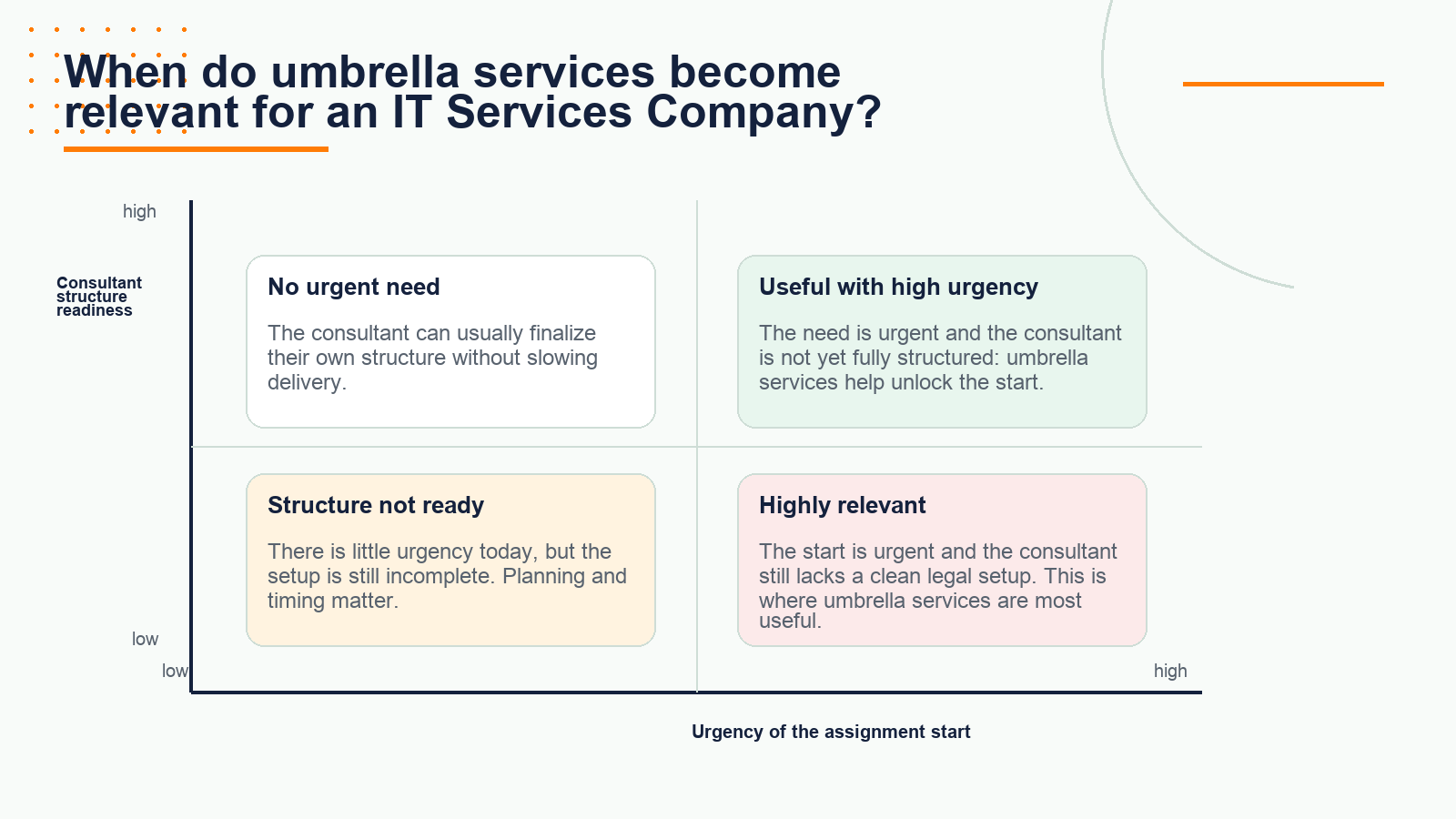
when a consultant has just left their permanent contract;
when a freelancer has not yet created their company;
- when an urgent mission requires rapid onboarding;
- when a consultant is transitioning between two structures;
- when an IT Services Company wants to avoid administrative issues delaying an already validated start.
- In these situations, the issue is not solely administrative. The real concern is to preserve commercial and operational responsiveness.
- What we think about it
As a leader of an IT Services Company, I have regularly encountered this scenario: a mission is secured, the consultant is validated, the client wants to start quickly, but the freelancer has not yet created their company or has not even begun the steps.
In this situation, the IT Services Company must navigate between two risks: delaying the start and managing client pressure, or moving too fast without having a sufficiently clean administrative framework.
Third Parties Umbrella Services are not a one-size-fits-all solution. When the need is anticipated, it is often better to allow the consultant time to create their structure. But in practice, it typically takes two to three weeks for a company to be fully operational and allow for contracting under optimal conditions.
It is also necessary to consider the issue of administrative compliance. An IT Services Company must collect and keep updated the necessary documents before and during the mission. However, when a company has just been created, some evidences are not always immediately available.
It is precisely in this type of configuration that Third Parties Umbrella Services make sense: when the mission needs to start quickly, when the consultant is available, but their structure is not yet ready.
For the consultant, this can also be a useful transition. They can quickly begin their mission and then create their company later, or choose to stay under umbrella services if they prefer to limit their administrative burden.
Final advice for talent acquisition or business development: anticipate this issue as soon as the consultant is identified. If they are in the process of launching their freelancing career, immediately check their progress in creating their structure, what documents are already available, and if the timelines are compatible with the start date expected by the client. This avoids a lot of unnecessary tension once the mission is secured.
In a broader operational responsiveness logic, this type of issue deserves to be treated at the same level as your other challenges related to
solutions for IT Services Companies
.If the topic also touches on the different uses of the umbrella services, you can complement it with our article on the differences between Payroll Management Services and Third Parties Umbrella Services
.Why do some projects get delayed before they start?Even when the client has approved the consultant, the IT Services Company still needs to finalize contracts and verify certain administrative and compliance elements. When the consultant is setting up their company or hasn't completed the necessary steps, this can delay the start.