
Why? Because between the commercial opportunity and the presentation of a truly mobilizable profile, there is often an operational gap that many organizations underestimate.
Today, clients no longer expect just a good pitch, or even great expertise on paper. They expect a fast, reliable and structured response. They want qualified profiles, available, validated, presented within a short timeframe, often between 48 and 72 hours.
That is exactly where many IT Services Companies fall short. Not because they lack the skills, but because they cannot activate them at the right moment.
The topic ties directly to a metric that has become central: time-to-staffing, that is, the time required to go from a client need to the presentation of a relevant consultant. But reducing the issue to speed alone is not enough.
The real topic is broader.
It touches on staffing governance, decision flow, talent pool structuring, anticipation capacity and, ultimately, the operational maturity of the IT Services Company.
To explore this angle further, it is worth also reading our article on time-to-staffing in IT Services Companies and the direct impact of sourcing responsiveness on conversion rates.
In short: 4 key takeaways
IT Services Companies rarely lose assignments through lack of expertise alone. They lose them mostly when they cannot mobilize the right profiles at the right tempo.
The problem often comes from a staffing model that is still too reactive, fragmented or insufficiently managed.
A structured staffing approach improves not just response speed but also delivery quality, business predictability and margin control.
Top-performing IT Services Companies are the ones that move from a search logic to an activation logic.
The real cost of a lost assignment in an IT Services Company
A lost assignment is never just an unsigned assignment.
It represents revenue that won't come in, of course, but its real cost is much broader. When an IT Services Company fails to respond within expected timelines, it sends an unfavorable signal to the client. That signal is not always explicit, but it is clearly perceived: lack of responsiveness, difficulty mobilizing, uncertain delivery capacity.
In the short term, this lowers the conversion rate. In the medium term, it can weaken the commercial relationship and degrade the IT Services Company's positioning on certain accounts. In environments where supplier panels are tight, a few late responses can be enough to lose visibility.
But the consequences are not only commercial. Internally, an unconverted assignment can extend bench periods, complicate utilization rate management and make revenue forecasts less reliable. The pressure then shifts to sales, recruitment and delivery teams, who must absorb the additional instability.
In other words, a lost assignment doesn't just affect the pipeline. It throws the entire performance chain off balance.
Why do IT Services Companies lose assignments today?
IT Services Companies don't lose assignments because they lack capability.
They lose them because they can't always quickly turn an available skill into a concrete client response.
The first hurdle is often a lack of coordination. The need is captured by sales, reformulated by recruitment, validated by operations, then refined after a discussion with the client. Every step is legitimate. The problem is that they often follow each other without a shared rhythm or clear acceleration mechanism.
The second hurdle relates to actual visibility on mobilizable resources. Many organizations talk about a talent pool, but in reality have a stock of contacts more than a usable qualified pool. Availabilities aren't up to date, specializations are poorly segmented, and activation remains craft-like.
The third hurdle is cultural. In many IT Services Companies, staffing is still seen as a consequence of the business, not as a strategic lever. The need is handled when it arrives, instead of organizing the response capacity upstream.
That's where the difference plays out between an IT Services Company that absorbs demand and one that's overwhelmed by it.
In the most demanding environments, a late response is enough to be ruled out.
Why does the classic staffing model no longer work?
The legacy model is well-known: a need comes in, you launch the search, tap the network, decide, then present.
For a long time this approach was enough. But it relied on a less tense market, longer decision cycles and clients more tolerant of delays.
That is no longer the case today.
Tension on IT talent, faster client decision-making and competitive pressure have profoundly changed the rules. From now on, an IT Services Company that only starts looking for a profile once the need is formalized is already lagging behind.
The problem is therefore not just slowness. It is the lack of anticipation.
A model based solely on on-demand search lacks predictability, complicates ramp-up and makes growth more fragile. Every need restarts almost from scratch, with its own friction, validations and uncertainties.
In this context, IT staffing can no longer be treated as a simple back-office mechanism. It becomes a competitive factor.
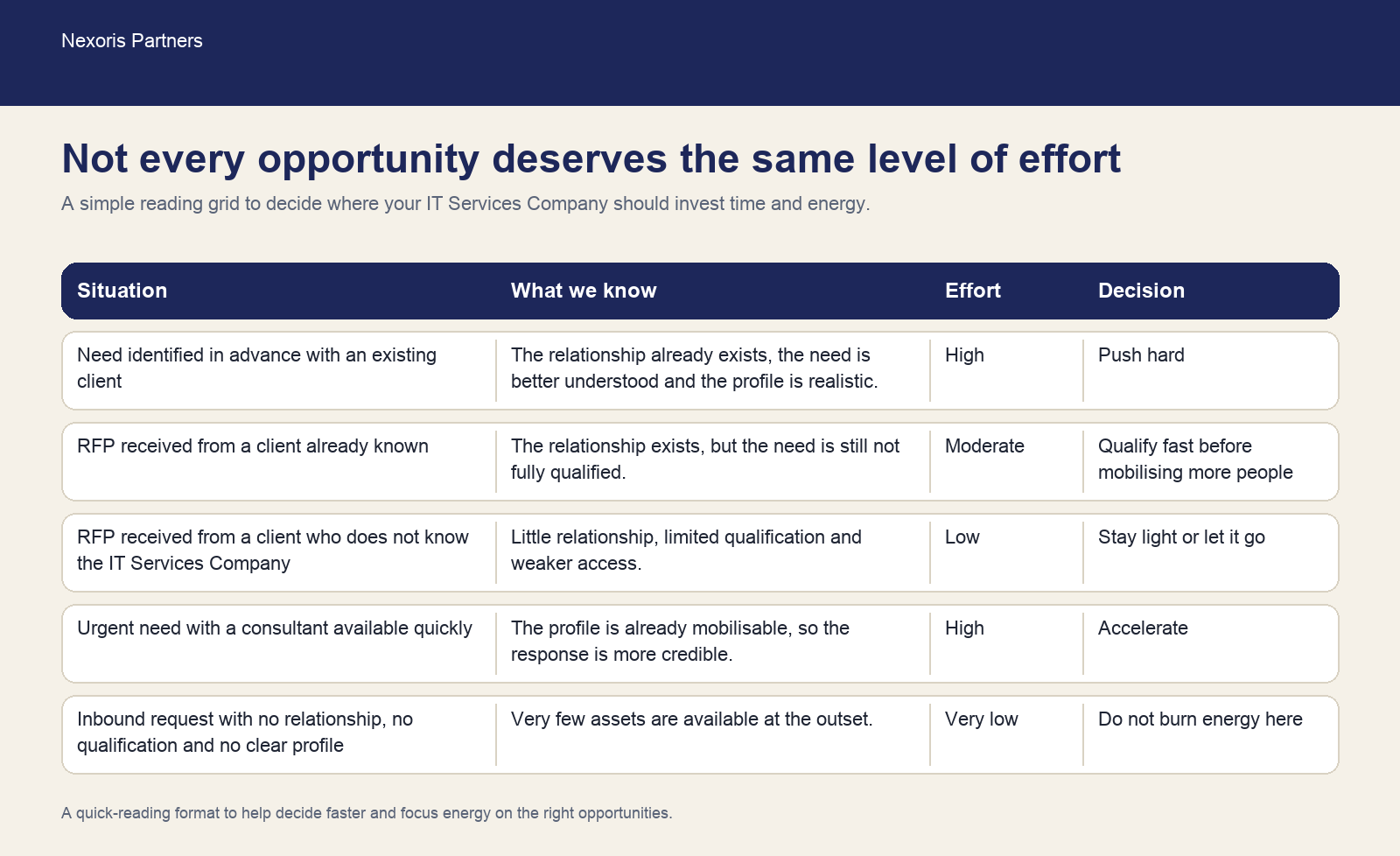
The winning staffing model: shift from a search logic to an activation logic
The most effective IT Services Companies don't win just because they have a strong network.
They win because they have structured their ability to activate that network quickly, cleanly and with a high level of reliability.
This first requires a truly usable pool of qualified consultants. Not a static database. Not an accumulation of CVs. A living, segmented, up-to-date talent pool, organized by expertise, types of assignments, availability levels and contracting criteria.
It then requires clear operating rules. Who validates? Within what timeframe? Based on which criteria? With what level of autonomy? As long as those answers are not made fluid, the best talent pool in the world will remain underused.
Lastly, a structured staffing model doesn't just aim to go faster. It aims to respond better. That means more relevant profiles, cleaner presentations, and a stronger ability to deliver afterwards.
That is when staffing stops being a series of micro-emergencies. It becomes a growth infrastructure.
To go further on this approach, our article dedicated to IT talent sourcing and reducing time-to-staffing usefully complements this discussion.
What signals show that an IT Services Company is losing assignments for the wrong reasons?
Some IT Services Companies think the market is simply tougher, when in fact several signals point to an internal structuring problem.
When sales people feel that "needs come in too fast," when recruiters feel they're always starting from scratch, when delivery teams find out about ongoing decisions too late, or when clients ask multiple times where the search stands, the issue is no longer cyclical but organizational.
Another common signal: the quality of profiles offered isn't necessarily the issue, but the response comes too late. In many demanding environments, a strong profile presented after the decision window often has less value than a solid profile presented on time.
You should also look at indirect indicators. A drop in conversion rate, a rise in bench time, response cycles that vary too much, or difficulty projecting staffing for recurring needs are often the symptoms of a model that isn't yet sufficiently steered.
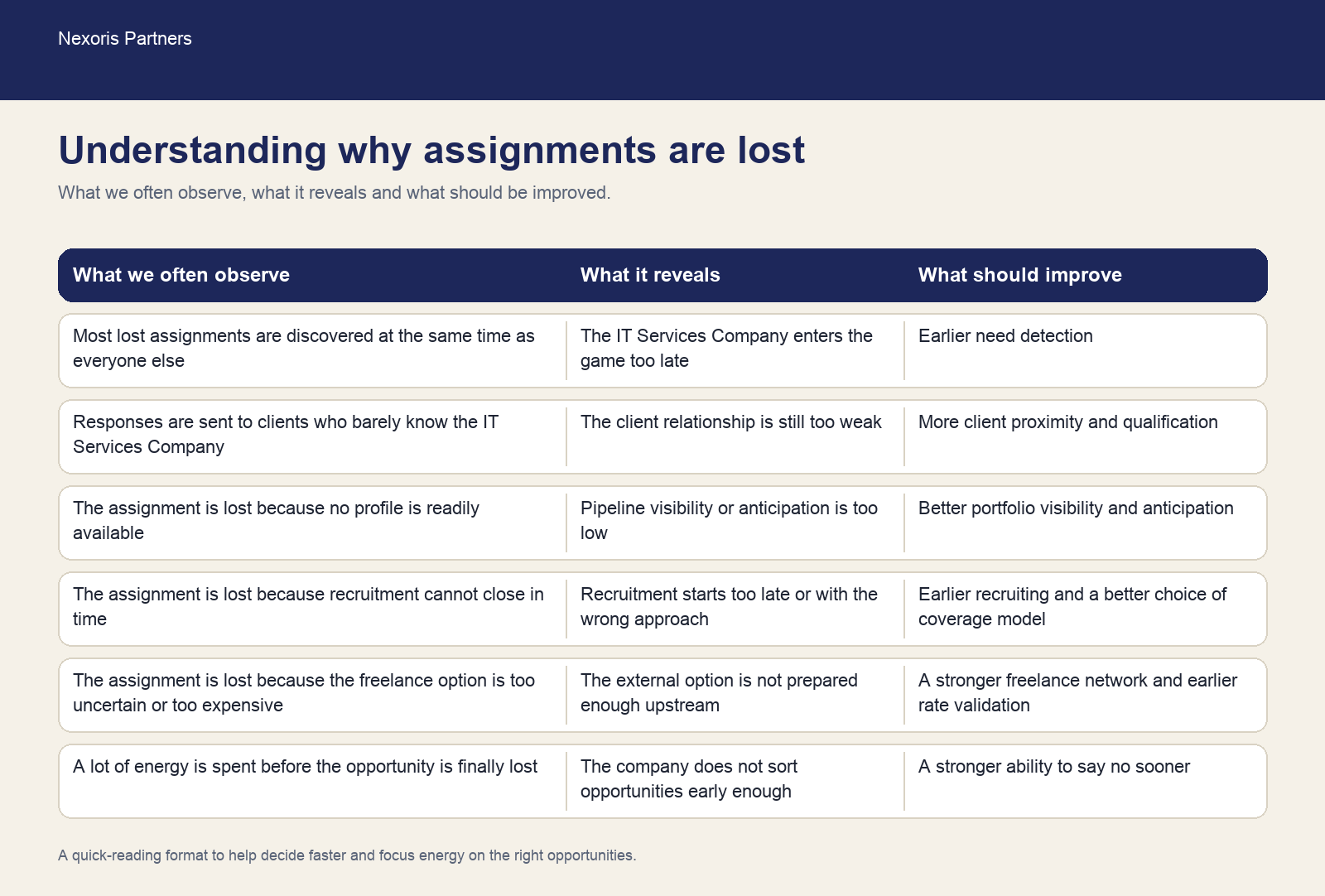
Structured staffing vs freelancer platforms: a trade-off between speed and control
Faced with short timelines, some IT Services Companies use freelancer platforms to save time.
In some cases, this makes sense. For example, to address a one-off need, to handle a topic outside the core business, or for profiles that are difficult to redeploy at the end of an assignment.
Platforms can then play two roles. Some operate like large CV databases, where the IT Services Company sources autonomously. Others provide search support with a more assisted approach. But in any case, they don't replace the internal organization.
Staffing accountability stays with the IT Services Company. A platform helps you find faster. But it doesn't structure processes, validations, or the ability to mobilize over time.
By contrast, structured staffing combines speed with control. The IT Services Company knows who it can mobilize, on what timeline, and under what conditions.
In other words, the platform is a tool. Staffing remains a system to build.
What impact on IT Services Company performance and growth?
When an IT Services Company truly improves its staffing model, it doesn't just gain time. It gains stability.
First, the conversion rate goes up, because responses are faster but also more relevant. Then, the utilization rate improves because resources are mobilized more effectively. Operating margin also becomes more readable, thanks to fewer non-billable periods and better activity continuity.
But there is an even more strategic benefit: predictability.
An IT Services Company that staffs cleanly is also better at projecting its activity, absorbing peak loads, securing client commitments and supporting steadier growth.
Staffing then becomes a performance lever comparable to the sales pipeline or margin management.
Our take
At Nexoris Partners, we believe many IT Services Companies still lose assignments for the wrong reasons.
Not because they lack skills, but because they can't respond at the right moment.
The problem isn't positioning. It's organization.
In many cases, the profiles already exist. But they aren't mobilized fast enough, or under the right conditions.
The point is not to have more consultants but to use the existing ones better. Concretely, this comes down to simple things: a clear talent pool, fast validations and better coordination across teams.
This makes it possible to respond faster without losing quality and without bloating the organization. For an IT Services Company, structuring staffing is no longer just an operational efficiency play but a strategic growth choice.
What to take away?
IT Services Companies don't just lose assignments because the market is demanding.
They often lose them because their response model is no longer aligned with the speed, precision and reliability now expected.
Those that take the lead are the ones that have stopped treating staffing as mere execution. They have structured it, steered it, and integrated it into their commercial strategy and delivery model.
They don't just look for profiles. They organize their ability to convert a request into a won assignment. And it's that difference that today separates IT Services Companies that drift through their growth from those that own it.